WW1 chaplain Fr Willie Doyle moves toward sainthood as Irish Church sends case to Vatican
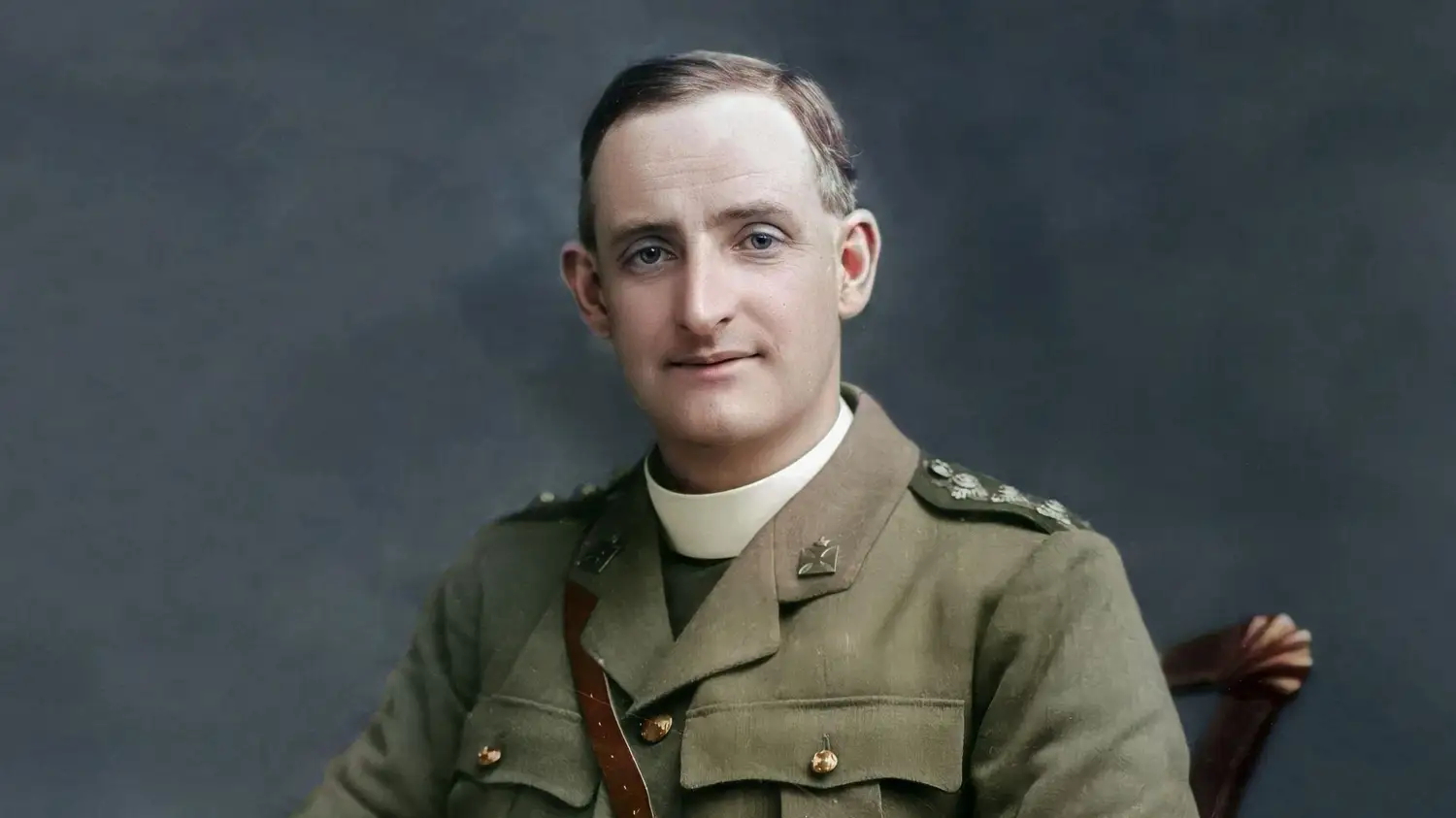
The Catholic Church in Ireland has moved a step closer to declaring Fr Willie Doyle a saint after completing its inquiry into his life and sending documentation to the Vatican.
Fr Doyle, a Jesuit priest from Dublin, served as a chaplain to the 16th (Irish) Division of the British Army during World War One. He was killed by shellfire on 16 August 1917 at the Battle of Passchendaele while going to the aid of two wounded Protestant soldiers, one of whom was 2nd Lt Arthur Vivian Green from Belfast.
The Church considers Fr Doyle an ecumenical martyr of charity because he died ministering to soldiers of other Christian denominations. He was awarded the Military Cross for bravery at the Battle of the Somme and was mentioned in despatches on a number of occasions.
A ceremony was held at Mullingar Cathedral on Sunday, where Bishop of Meath Tom Deenihan sealed the documentation with wax, as required by church regulation. The process marks the completion of the diocesan inquiry, which began in 2022.
The documentation, close to 3,500 pages, was gathered by a theological commission studying his writings, a historical commission studying his life, and a diocesan tribunal during which experts were interviewed. The parcels were wrapped in red ribbon and sealed with wax by the bishop.
The campaign for sainthood is led by the Fr Willie Doyle Association, founded in 2020 by Patrick Kenny, a business school lecturer from south County Dublin. Kenny said Fr Doyle lived a life of great heroism and holiness, and his letters home provide a key eyewitness source for historians studying the Irish in World War One.
Kenny said the commander of the 16th (Irish) Division, Maj-Gen Sir William Bernard Hickie, described Fr Doyle as the bravest man he ever met. He added that Fr Doyle was held in great esteem by his own men and was noted for his kindness towards injured German prisoners-of-war.
Bishop Deenihan said the example of an Irish Catholic priest who died serving as a British Army chaplain has much to offer our own time when nationality and denomination run the risk of polarity. He said he was confident the case would be successful.
The next phase involves the documentation being examined in Rome. The process of canonisation has several steps and can take many years.