Repairs Nearly Complete on Slieve Gullion Passage Tomb Ahead of Winter Solstice
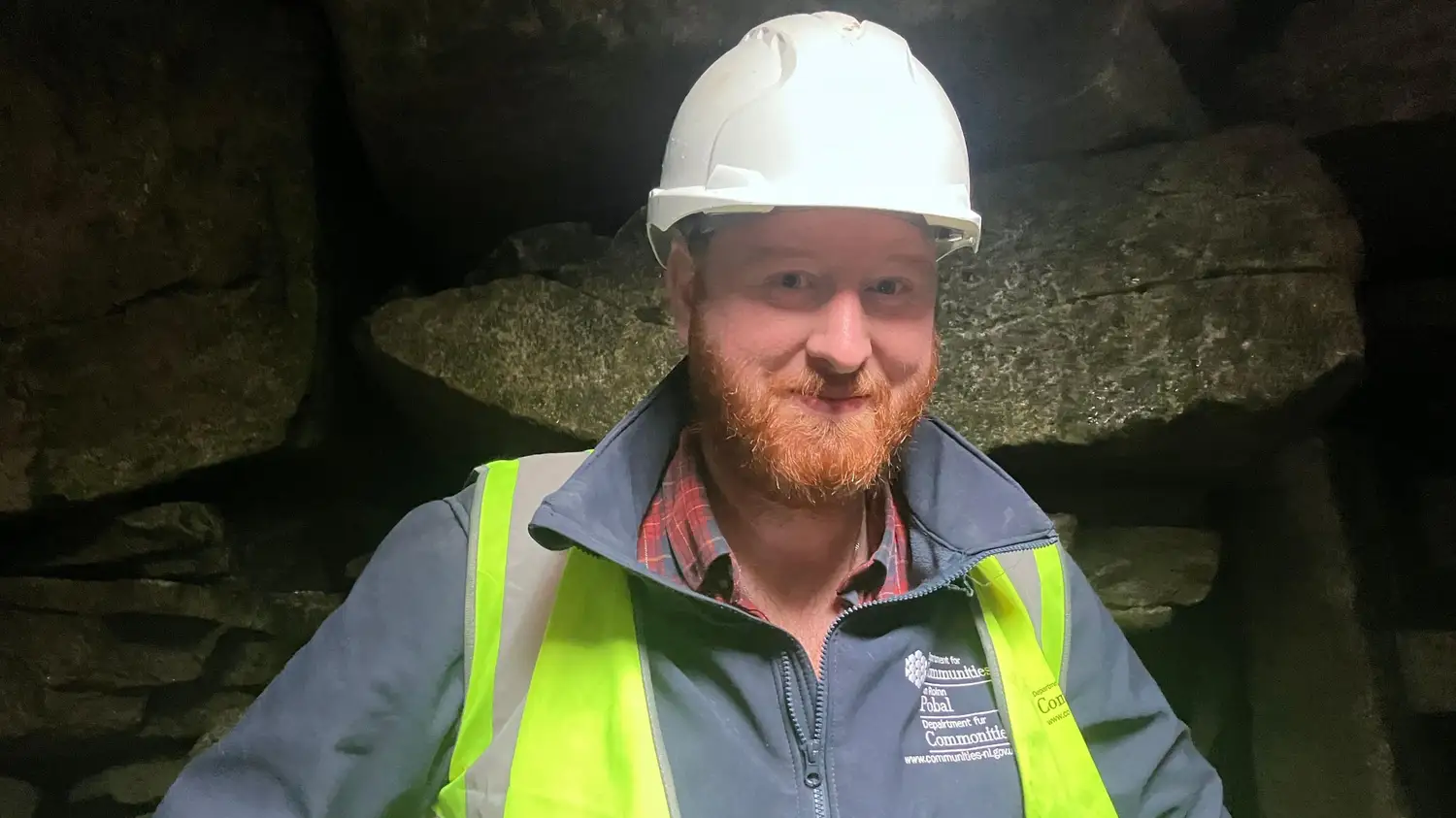
Repair work on the Slieve Gullion passage tomb in County Armagh is nearing completion and should be finished in time for the winter solstice on December 21.
The 5,000-year-old Neolithic structure was closed last year after an engineering report found the roof installed in the 1960s had become dangerously corroded and was close to failure. Historic Environment Division archaeologist Stuart Alexander said the team had spent a year planning the repair work before beginning this project.
The tomb is famous for the winter solstice alignment, when sunlight floods the chamber at sunset. The repair work includes replacing corroded steel beams with four new beams, along with new plates and a cage to allow light to enter.
Blacksmith apprentice Lucas Adams, who previously worked on restoring 18th Century cannons at Carrickfergus Castle, has been creating the new roof. He said the work is satisfying because it allows him to travel around the country and work on ancient places.
Project manager Owen Mort is monitoring the structure for any movement using a device called a tell-tale. He said a number of cracks had developed over the years, and the team is taking measurements to ensure they do not open further.
The tomb sits at 1,880 feet on the summit of Slieve Gullion, the highest mountain in County Armagh. Most building materials had to be carried up the mountain each day, a hike of about 40 minutes from the highest car park, though some materials were dropped by helicopter.
The work required ecological permissions from the Department of Agriculture, Environment and Rural Affairs because the tomb is located in an Area of Special Scientific Interest.
Once completed, the tomb will look much as it always has: a huge mound of loose rocks with a small entry point visible from the south-west side. The Historic Environment Division, a subsection of the Department for Communities, is overseeing the project.
Armagh Observatory and Planetarium astronomer Dr Rok Nežič explained that the autumn equinox occurs on September 23 this year, just after 1am. On the equinox, the sun rises exactly in the east and sets exactly in the west.
In the observatory grounds there is a modern stone calendar that shows the sunset directions for the equinoxes and solstices. Dr Nežič said many stone circles around the country focus on the solstices because they are more significant, but some also incorporate equinoxes in their design.