Coroner rules Jamie Wilson died of natural causes following PSNI custody in 2018
A Northern Ireland coroner has ruled that Jamie Wilson, who died on 7 May 2018 in the Intensive Care Unit of Craigavon Area Hospital, died from natural causes. Coroner Maria Dougan, delivering her findings on 23 April 2026, determined that the cause of death was infarction of the left cerebral hemisphere due to thrombosis of the left internal carotid and left middle cerebral arteries. She found, on the balance of probabilities, that the stroke was caused by paroxysmal atrial fibrillation in the context of chronic alcohol and drug misuse, dehydration, and associated risk factors.
Wilson, born 29 July 1984, of 75b Drone Hill Road, Corbet, Banbridge, had been arrested in the early hours of 30 April 2018 following a reported assault on his partner at his home. He was conveyed to Banbridge Custody Suite, where he required physical restraint by PSNI officers on arrival. He was released on bail at approximately 15.17 hours on 30 April 2018. On the evening of 1 May 2018, he was found by his sister and a neighbour in a confused state with right-sided weakness and vomiting. He was taken by ambulance to Craigavon Area Hospital, where imaging confirmed a large left-sided cerebral infarct. He was subsequently transferred to the Royal Victoria Hospital, then returned to Craigavon Area Hospital, where he died on 7 May 2018 following confirmation of brainstem death.
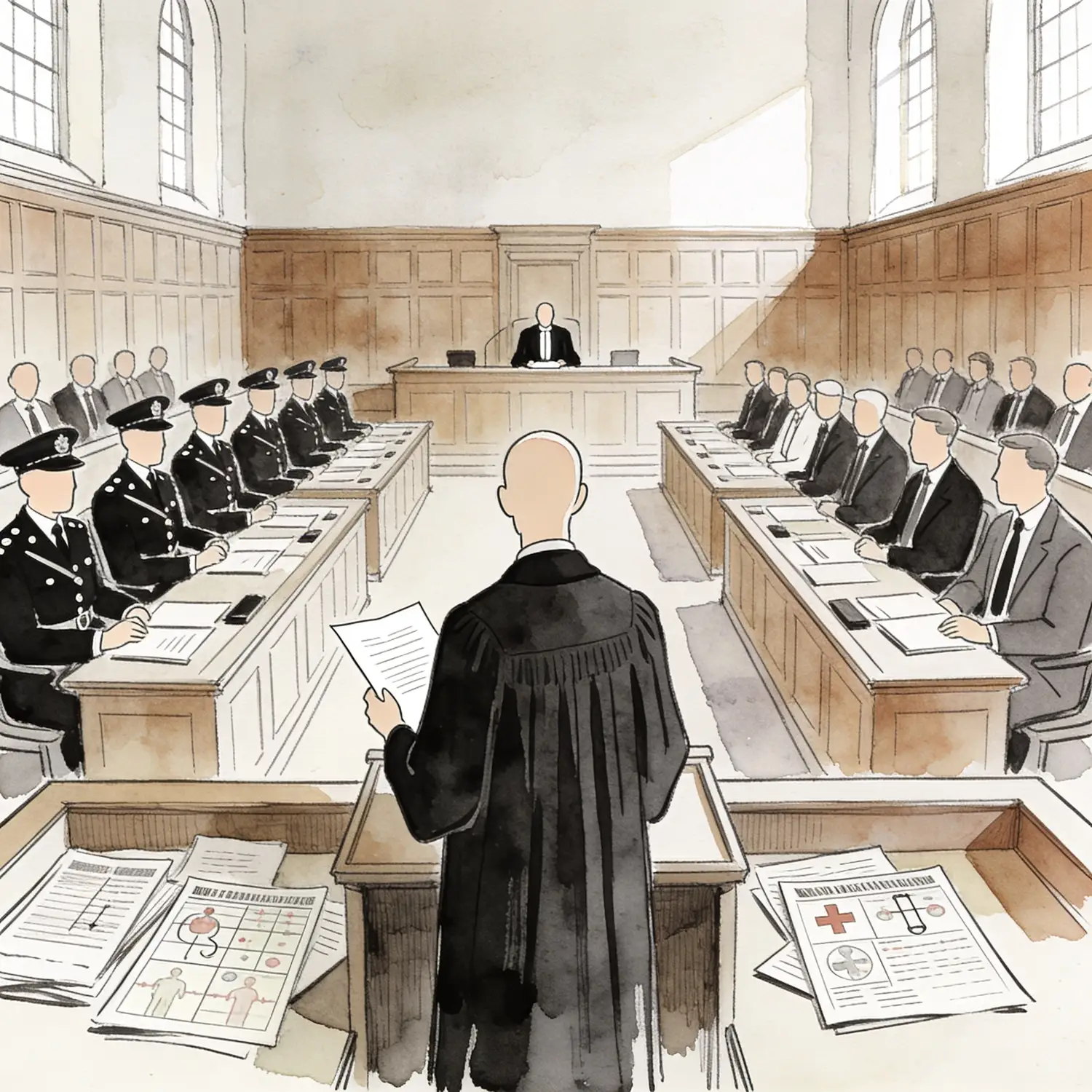
The inquest, held at Banbridge Courthouse over six days in March 2025, heard from 15 oral witnesses and admitted 23 written statements, along with medical records, CCTV footage, and expert reports. The coroner considered evidence from pathologists, neurologists, a custody expert, and forensic medical officers. The inquest had been preceded by a Police Ombudsman investigation, with the Public Prosecution Service directing in 2022 that no criminal prosecution of any PSNI officers would proceed.
Coroner Dougan identified several failings during Wilson's custody but found that none caused or contributed to his death. She found that Constable Morrison used a headlock - not a recognised or trained technique - during restraint at the custody suite, and that Constable Mackin used a kick towards the deceased that was similarly not a recognised technique. She found that Wilson remained in the prone position in the corridor and subsequently in the cell for longer than was appropriate. She also found that information about Wilson striking his head against the vehicle window during transport was not passed to the custody sergeant, which represented a departure from best practice.
The coroner found that the two assessments carried out by Forensic Medical Officer Dr Richard Harrison on the morning of 30 April 2018 were inadequate. Dr Harrison's first assessment, at approximately 08.06 hours, lasted around 45 seconds. His second, at approximately 11.10 hours, lasted approximately 21 seconds. Coroner Dougan found that more detailed histories should have been taken in both instances, particularly regarding alcohol intake and seizure history, and that fuller clinical examinations should have been performed. She found that Dr Harrison's assessments fell below what would reasonably have been expected of a Forensic Medical Officer. She found that Dr Brian Cupples, the earlier FMO on duty, had acted appropriately in his role.
On the question of a seizure episode observed in the cell at approximately 06.50 hours on 30 April 2018, the coroner preferred the evidence of consultant neurologist Dr Bhavini Patel over that of Dr Richard Hardie. She found that Wilson had suffered a generalised seizure most likely attributable to alcohol-related factors, including chronic alcohol use, possible withdrawal, and dehydration, and that this was a separate and unrelated event from the stroke which occurred more than 24 hours later. She found that trauma before, during, or after police custody did not cause or contribute to the death, and that the restraint of Wilson did not cause or contribute to his death. Expert evidence indicated that earlier hospital intervention would not have altered the outcome, as the infarction was already established and irreversible by the time Wilson was admitted to Craigavon Area Hospital.