Court of Appeal Dismisses Planning Challenge Against Lisburn Housing Approval
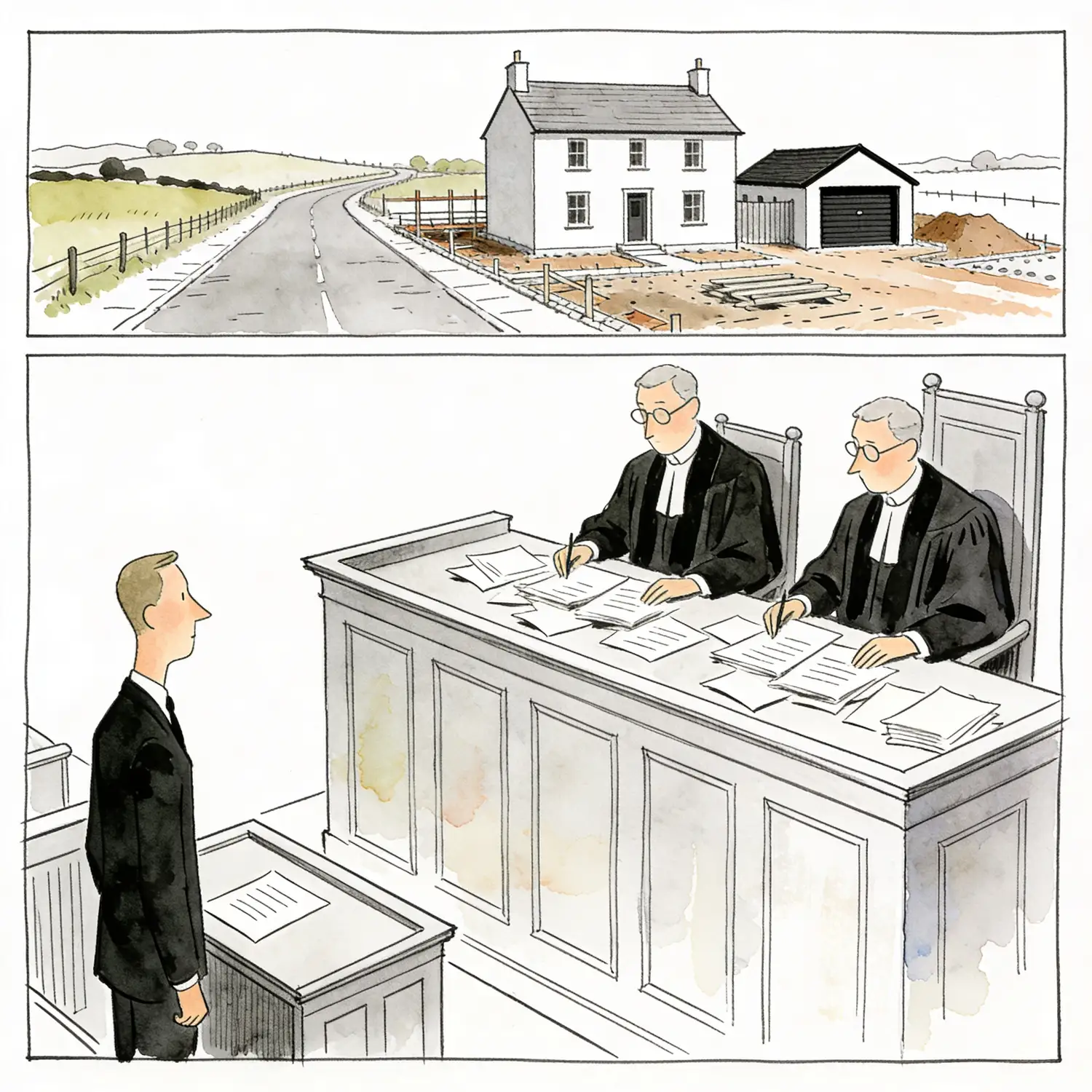
The Court of Appeal in Northern Ireland has dismissed an appeal by Gordon Duff against a decision by Lisburn and Castlereagh City Council to grant reserved matters approval for the construction of a new dwelling with a detached garage on the Hillhall Road, Lisburn. The Council granted that approval on 20 October 2023.
The outline planning permission for the site had originally been granted on 3 May 2019 under Policy CTY8 of PPS 21, which permits infill dwellings in principle. Duff did not challenge that original permission at the time. Reserved matters approval was subsequently granted in September 2021, and building control approval followed shortly after. Work on the foundations began in December 2021. Duff later challenged the reserved matters approval, which the Council ultimately confirmed on 20 October 2023.
Duff, who represented himself, argued that the approval was so fundamentally flawed that no lawful reserved matters approval consistent with planning policy could be granted. The High Court had granted him leave to proceed on certain grounds in 2024 but refused leave on others. He appealed those refused grounds to the Court of Appeal, contending he had established arguable cases with a realistic prospect of success. The panel, comprising Treacy LJ and Horner LJ, dismissed the appeal on the merits at the conclusion of the oral hearing, with Treacy LJ delivering the judgment.
A central issue in the judgment was whether Duff had standing to bring the challenge. The court noted that Duff has pursued numerous judicial review applications over the years, seeking in effect to act in a representative capacity on behalf of the public, and that he is not an active member of any organisation concerned with the environment. No environmental organisation or NGO had raised any challenge in this case. The court also noted that there had been no objectors when the reserved matters application was made, and that all statutory consultees had agreed to the approval.
The court described Duff as having been solely responsible for generating a wholly disproportionate volume of litigation, largely in the planning context, which it said had caused feelings of unfairness and hardship to individuals involved. It found that he was not a suitable representative of the public interest, and that courts must be careful not to encourage litigation by those acting as busybodies, in order to avoid unnecessary cost and delay.
The judgment set out the value of recognised environmental organisations in such proceedings, noting that they apply specialist knowledge when assessing the merits of environmental challenges, identify grounds of challenge with precision, and typically engage expert legal representation. The court said these factors help ensure that only meritorious challenges are brought and that proceedings are conducted in an informed and orderly manner.
On the grounds where leave had been granted and not appealed, the court held that the question of Duff's standing on those grounds should be considered by the judge allocated to hear that matter.