Minister unveils transport strategy aiming to cut car use and boost alternatives
Infrastructure Minister Liz Kimmins has published a new strategy outlining plans for a cleaner, smarter and more inclusive transport system by 2035.
The Transport Strategy 2035 sets out goals to decarbonise transport by reducing private car journeys, switching to zero and low emission fuels, and encouraging greater use of public transport.
Data in the strategy shows that on average 68 per cent of journeys in Northern Ireland are made by car, while 24 per cent are on foot, 3 per cent by public transport and 1 per cent by bicycle.
Cars account for 71.6 per cent of greenhouse gas emissions from surface transport, with heavy duty trucks and buses next at 18.8 per cent and light duty trucks at 8.2 per cent.
The strategy notes that about 40 per cent of social housing tenants do not have access to a car, compared with a lower average across the region overall.
It states that in urban areas such as parts of Belfast and Derry, communities with lower levels of car ownership can experience some of the worst impacts from traffic congestion, such as poor air quality. Those who contribute least to the problem can feel the impacts the most, the document says.
In rural areas, limited transport alternatives and longer travel distances can restrict access to essential services and opportunities for those without a car, it adds.
The document also references a 2023 research report which found that 61 per cent of people said it would be difficult to reduce their use of private cars, rising to 78 per cent in rural areas.
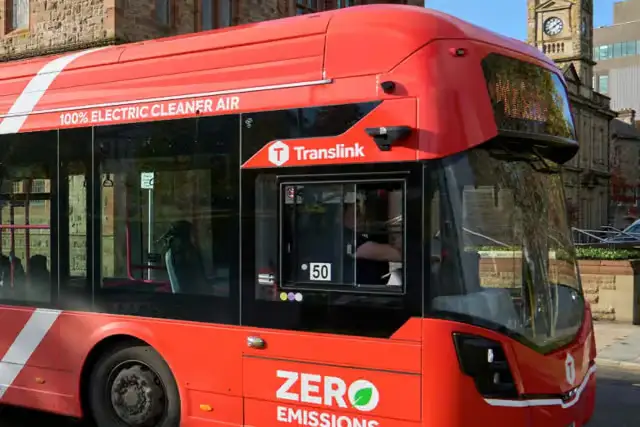
Progress on decarbonising transport is noted in the strategy, with considerable funding already provided or committed for zero and low emission buses in Belfast and Derry. Derry's Foyle Metro fleet went fully electric three years ago.
The strategy says an electric bus is currently more expensive than a Euro 6 compliant diesel bus, so affordability and the most effective means to reduce carbon emissions will need to be considered before full replacement of all Translink buses and coaches.
Rail improvements also form part of the strategy, which cites the 2024 All-Island Strategic Rail Review. One recommendation is that the Derry to Portadown rail connection be reopened as a long-term intervention by 2050.
The strategy also says that in June 2026 the Irish Government announced Shared Island funding for capital expenditure on rail projects on the Northern Ireland rail network, providing a valuable opportunity to accelerate delivery of key rail projects identified in the review.
Alongside the strategy, the Department for Infrastructure launched a consultation on the draft Eastern Transport Plan 2035 for the Belfast area.
Key proposals for Belfast city centre include more pedestrian-priority streets and creation of a new civic spine, a 20mph speed limit across the city centre, new Glider routes, simplified bus routing, an expanded segregated cycling network, and reduced through-traffic alongside reforms to parking management.
Across the wider Belfast metropolitan area, proposals include new Glider corridors on key radial routes, new and upgraded cycling infrastructure, targeted 20mph zones, new and expanded park and ride sites, and strategic transport network upgrades including bus priority measures.
The consultation is open until 25 January.
A draft North West Transport Plan for the Derry area is expected to be published in early 2027, focusing in greater depth on shorter, local transport movements.