Presbyterian Assembly Votes to Retain NDAs, Narrowly Backs Climate Conference
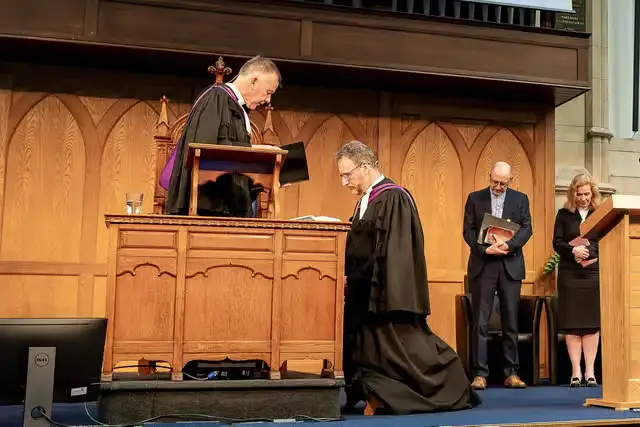
The annual General Assembly of the Presbyterian Church in Ireland convened in Belfast, with representatives from more than 500 congregations across the island discussing matters including the use of settlement agreements, a climate change conference, and church restructuring.
Newly installed Moderator Rev Richard Kerr from Templepatrick chaired the proceedings. His chosen theme for the year is God’s love, based on the verse John 3:16. Among his personal chaplains is Rev Dr Karen Campbell, who offered a prayer before the assembly’s communion service. She referred to recent disorder, lamenting the burning of homes, shops and cars, and the intimidation caused by masked individuals threatening a fragile peace.
One of the most debated topics was the church’s policy on non-disclosure agreements, or settlement agreements. A task group recommended their continued use in limited circumstances, a position endorsed by Ken Swarbrick of the General Council. He argued that such agreements are widely supported in the legal profession and by the Employment Tribunal Office, and that the church has a moral duty to protect staff from false and malicious allegations. He disclosed that in the past five years, settlement agreements were used in only nine out of 650 departures, representing less than 1.4 percent of cases.
Several ministers raised objections. Rev Colin Burkham of Mersey Street Church in east Belfast said the figures did not reflect wider concerns about truth, justice and accountability. Rev Susan Moore, a former solicitor and missionary, criticized the secrecy surrounding the agreements, saying she had seen one that was so restrictive a signatory could not even disclose they had signed it. She said the church should not adopt practices she likened to a communist society. Rev Jim Stothers, a retired deputy clerk, insisted the agreements protect innocent employees who might otherwise have to defend themselves publicly. Elder James Livingstone, who spent decades in NHS tribunals, added that the agreements are typically negotiated with union lawyers rather than imposed. After a voice vote, the assembly decided to retain their use in limited circumstances.
The assembly also considered a resolution giving thanks for a conference on the theme of God’s world or responsibility. Retired minister David Johnston from Bangor objected, arguing that when the event was planned two years ago he was promised a dissenting view on human-induced climate change would be heard but that the conference was entirely one-sided in practice. His concerns were supported by Rev Alan Wilson from Ballykelly. Rev Uel Mars, Secretary to the Council for Global Mission, said he was sorry for the disappointment, emphasized the church has no official position on human-induced climate change, and stated the conference aimed to highlight commonly used distortions of scientific facts. A counted vote resulted in 61 votes for the resolution and 50 against.
In other business, delegates debated a planned root-and-branch review of church structures. An interim report was to be sent to Presbyteries and Church Councils with a response deadline of 6 November, but the assembly amended the motion, requiring every church council to provide a vision of its work. The full report and councils’ visions must now be circulated by 1 February 2027, and the panel’s recommendations will undergo theological and legal review before an update is brought to the next assembly.