Nine Men Face Trial Over Lyra McKee Murder Night Riots as Judge Rules Key Evidence Admissible
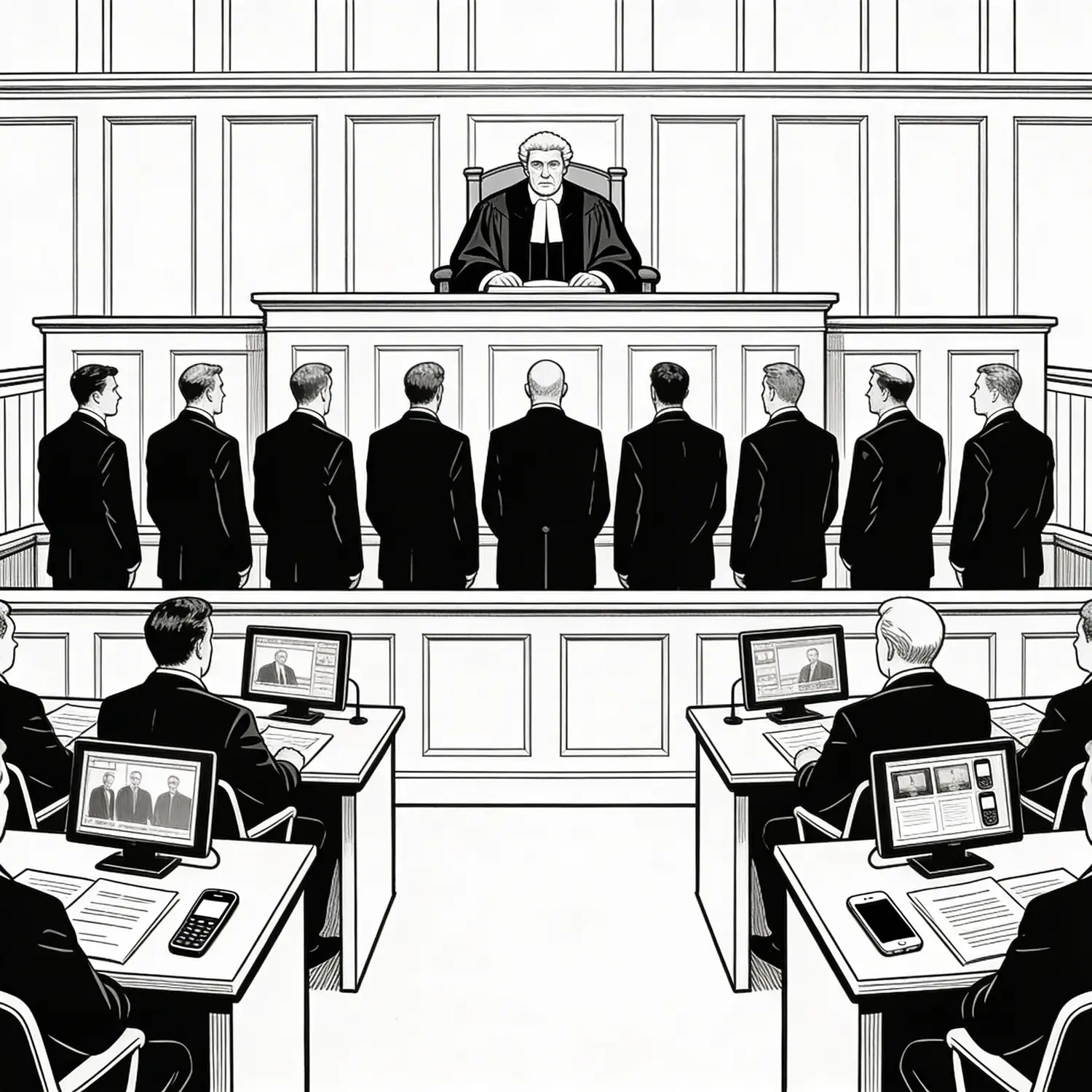
A Crown Court judge in Belfast has ruled on a series of contested evidence applications in the trial of nine men charged with riot and related offences arising from the civil disturbance in Derry on 18 April 2019, the night journalist Lyra McKee was shot dead in the Creggan area. Three of the defendants - Paul McIntyre, Peter Cavanagh and Jordan Devine - also face murder charges, not as the alleged shooter but on the basis that they intentionally encouraged or assisted the gunman.
Smyth J delivered the ruling at Laganside Courthouse on 27 February 2026 following applications by all nine defendants at the close of the prosecution case. The defendants are Paul McIntyre, Christopher Gillen, Jordan Devine, Peter Cavanagh, Joseph Barr, Forest Coffey (also known as McCrory), Joseph Farren (also known as Campbell), Patrick Gallagher (also known as Mellon) and Kieran McCool. All are charged on a joint enterprise basis. Some defendants face additional charges relating to a separate riot two days earlier, on 16 April 2019.
The prosecution case rests on several evidential strands including commercial footage from MTV, which was filming a documentary about the republican group Saoradh on the night in question, footage from a French television company covering the 16 April disorder, police recognition evidence from controlled viewings, imagery analysis expert evidence, DNA evidence, cell site data and a disputed statement by one defendant. The judge was required to rule on the admissibility of each strand before determining whether any defendant had a case to answer.
On the MTV footage, the judge rejected defence arguments that it was unlawfully obtained or inadmissible on grounds of authenticity. A production order had been granted at Londonderry Crown Court on 3 May 2019 against Viacom, the owner of MTV, and the material was voluntarily handed over the same day. The judge found that a Northern Ireland court had the power to make such an order in respect of material held elsewhere in the United Kingdom, relying on section 86(3) of the Criminal Justice and Police Act 2001. She ruled that any interpretation limiting the word "premises" in the relevant legislation to Northern Ireland alone would produce an absurd result inconsistent with parliamentary intention. Both the MTV and French television footage were admitted as at least prima facie authentic, with final determination of authenticity reserved for the end of the trial.
The judge reached a sharply different conclusion on police recognition evidence from controlled viewings. A central concern was an informal viewing of footage held at Waterside police station on 10 July 2019, arranged by DC Moore, a member of the Major Investigation Team, who played higher-quality footage from appeal 24/19 to a group of officers from the District Support Unit without any controlled procedure, notebook entries or notification to the Senior Investigation Officer. The judge found that all officers present knew at the time that the viewing breached Code D of the PACE Code of Practice, concluding that the complete absence of any note, email or mention in subsequent statements supported that finding. The Waterside viewing only came to light during committal proceedings following disclosure requests by defence legal teams. Separately, the judge found that multiple officers had accessed the NICHE police intelligence system to retrieve images and personal details of suspects before and after controlled viewings without disclosing this to identification officers. She ruled that the cumulative breaches of Code D were so serious that purported recognitions of the masked defendants - specifically McIntyre, Cavanagh and Campbell - could not be considered reliable or admissible. She added that even if the evidence were technically admissible, she would have excluded it under Article 76 of PACE on fairness grounds, and would in any event have attached no weight to it.
On expert imagery analysis, the judge admitted the evidence of Andrew Wooller of Acuity Forensics, who compared clothing and personal features of masked individuals in the footage with reference material seized from defendants or observed during stop and search encounters. She accepted that imagery analysis falls within a recognised field of expertise and that Wooller's evidence was given in a balanced manner with appropriate acknowledgment of limitations. The absence of ISO 17025 accreditation, which the judge noted no imagery analyst in the United Kingdom had yet obtained, was found to have no bearing on admissibility. By contrast, the judge excluded the evidence of a second imagery analyst, Matthew Stephens of Diligence, under Article 76 PACE. She found his independence had been undermined by repeated contact with the Senior Investigation Officer, the disappearance of a case brief and meeting notes, and his willingness to amend conclusions in his draft reports following police requests without disclosing the fact or rationale of those changes in subsequent versions. She concluded his evidence could not be regarded as the independent product of an expert witness.
On supporting evidence specific to individual defendants, the judge noted that DNA matching Cavanagh's profile was found on a zip pull recovered from burning material near a hijacked car after the shooting, with the probability of a coincidental match calculated at less than one in one billion against the Northern Ireland population. Cell site evidence placed Cavanagh's phone in the Creggan area throughout the relevant period, though the judge noted it did not place him precisely at the Central Drive and Fanad Drive junction. For McIntyre, cell site data showed his phone was removed from the network shortly before the first round of petrol bombing and reconnected approximately 15 minutes after the shooting. For Campbell, prosecution evidence included a gait analysis expert who found moderate support for the identification and a signed police statement of 23 April 2019 in which Campbell was alleged to have falsely stated he was at home during a period when footage placed him near the Saoradh office.
The judge refused all applications for a stay on grounds of abuse of process. She acknowledged significant and inexcusable breaches of Code D but found that a fair trial remained possible, that the relevant material had been fully exposed in the course of proceedings, and that there was no evidence implicating the Senior Investigation Team or the Public Prosecution Service in DS Moore's conduct at Waterside. The applications for no case to answer were not finally determined in this ruling, which addressed only the admissibility questions required to be resolved first.