Court of Appeal Orders Double Murderer Robert Clarke Back to Prison After Unlawful Release Under Good Friday Agreement Scheme
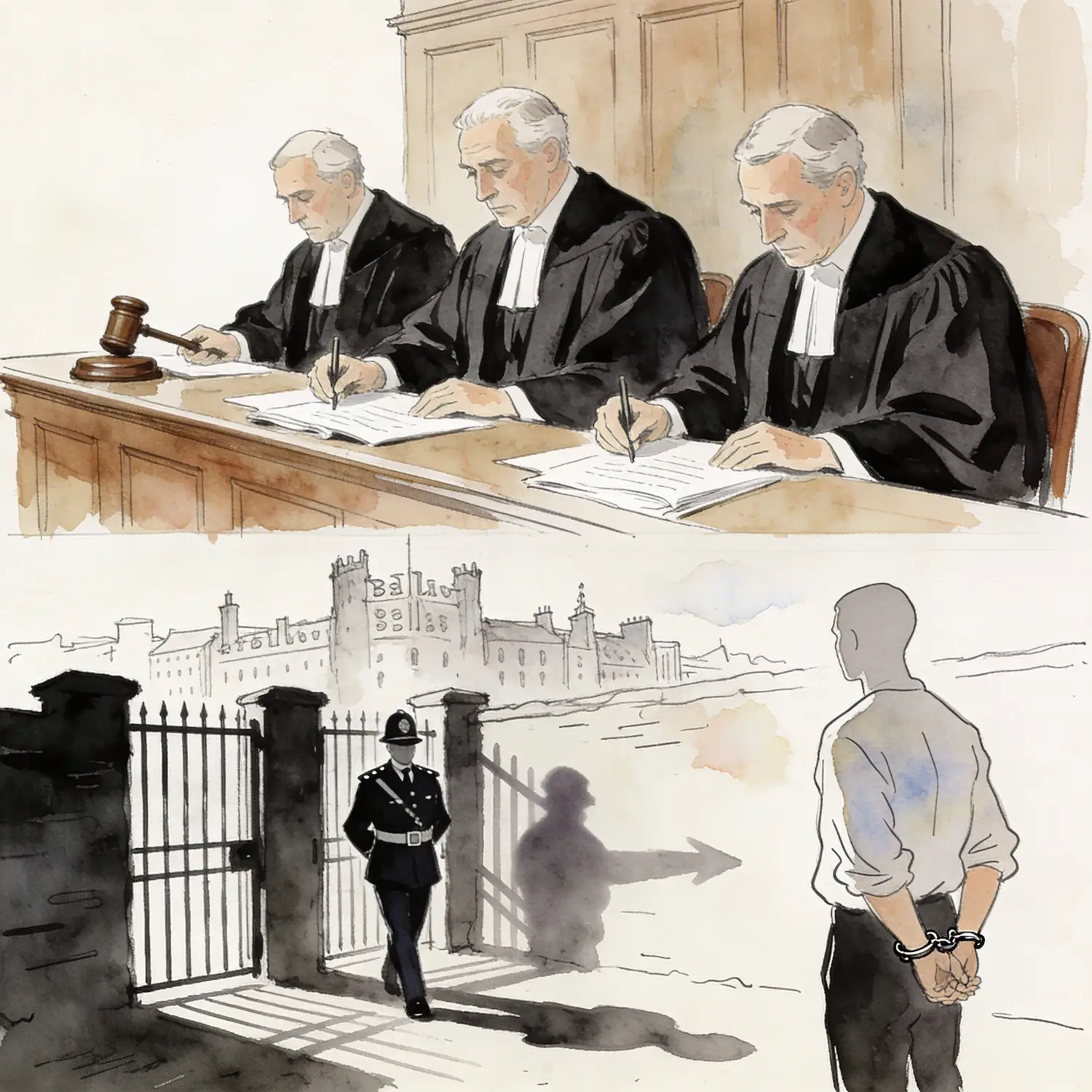
Northern Ireland's Court of Appeal has ruled that Robert Clarke, convicted of two separate murders, must return to prison after his 2013 release under the Good Friday Agreement prisoner release scheme was found to have been unlawful. The court, comprising Lord Chief Justice Keegan, Treacy LJ and Colton LJ, delivered its judgment on 12 March 2026, dismissing both of Clarke's appeals against decisions made by Scoffield J at first instance.
Clarke was convicted in 2011 of the murder of Alfred Fusco, who was shot dead at his ice-cream parlour and fish and chip saloon on 3 February 1973. Clarke had previously been convicted in 1976 of a separate murder - that of Margaret O'Neill - for which he served approximately 15 years before being released on licence in 1990. Following his 2011 conviction for the Fusco murder, Clarke was sentenced at Belfast Crown Court on 8 April 2011 to a life term with a minimum of 25 years, giving a tariff expiry date of 27 February 2036.
In 2012, Clarke applied to the Sentence Review Commissioners (SRC) for accelerated release under the Northern Ireland (Sentences) Act 1998, the legislation enacted to give effect to the prisoner release provisions of the Belfast (Good Friday) Agreement. The SRC granted a declaration of eligibility in November 2012 and Clarke was released on licence in February 2013. However, the offence for which he had been convicted was committed in 1973, before the earliest relevant emergency legislation came into force. This meant it was not a qualifying offence under the 1998 Act at the time of his application, and his release was therefore granted in error of law. The SRC's application forms did not require the date of the offence to be stated - only the date of sentencing - though the date was referenced in the covering letter from Clarke's solicitors. The criminal record provided to the SRC disclosed the date of offending, but no submission was made by the Northern Ireland Office on this point.
The error came to light in December 2019 when the Public Prosecution Service raised a query with the SRC in the context of a bail application for a separate individual. The Secretary of State for Northern Ireland subsequently initiated judicial review proceedings in April 2022. On 20 June 2024, Scoffield J granted a declaration that the SRC's decision had been unlawful, a finding agreed by all parties. A further hearing on remedy followed, and on 30 May 2025 the judge granted an order of certiorari quashing both the SRC's declaration of eligibility and the licence under which Clarke had been released.
The Court of Appeal upheld that quashing order. The court rejected Clarke's argument that the legal error was merely technical in nature, finding that it related to a fundamental question - whether Clarke was eligible for release at all. The court also upheld the judge's conclusion that no significant prejudice to Clarke outweighed the public interest in quashing the unlawful decision. The court noted that Clarke had received a sentence of two years for revenue offences in 2016 and a suspended sentence in 2020 for a related money laundering offence, though it acknowledged the Secretary of State had not moved to suspend Clarke's licence on those grounds.
A separate strand of the appeal concerned Clarke's application in May 2024 for fresh release under the 1998 Act as amended by the Northern Ireland Troubles (Legacy and Reconciliation) Act 2023. That amendment extended the definition of qualifying offences to cover conduct arising from the Troubles between 1 January 1966 and 8 August 1973, which meant Clarke's offence would now qualify. However, the SRC refused that application in September 2024 on the basis that Clarke was not in custody at the time and therefore did not meet the requirement under section 3(2) of the 1998 Act that an applicant must be a prisoner serving a sentence of imprisonment.
The Court of Appeal upheld that refusal. The court found that both the ordinary meaning of the statutory language and its context and purpose required an applicant to be physically detained in custody at the time of application. The court noted that the Act consistently uses the word "prisoner" when referring to those applying for release and the word "person" when referring to those already released on licence, a distinction it described as striking. The court also cited the SRC's own procedural rules, made two days after the Act was passed, which provide that hearings be held at the prison where the person concerned is detained. The court concluded it would be an absurdity for a declaration of eligibility for release to be granted to someone not actually in custody.
The practical consequence of the court's rulings is that Clarke must return to prison. Once in custody, he may make a fresh application to the SRC for release under the 1998 Act as amended by the 2023 legislation. The court noted that it is for the SRC, not the courts, to determine whether he qualifies for release, and that the onus rests on Clarke to demonstrate he meets the statutory conditions, including that he would not pose a danger to the public.