Ofcom details methods for age checks as UK social media ban for under-16s approaches
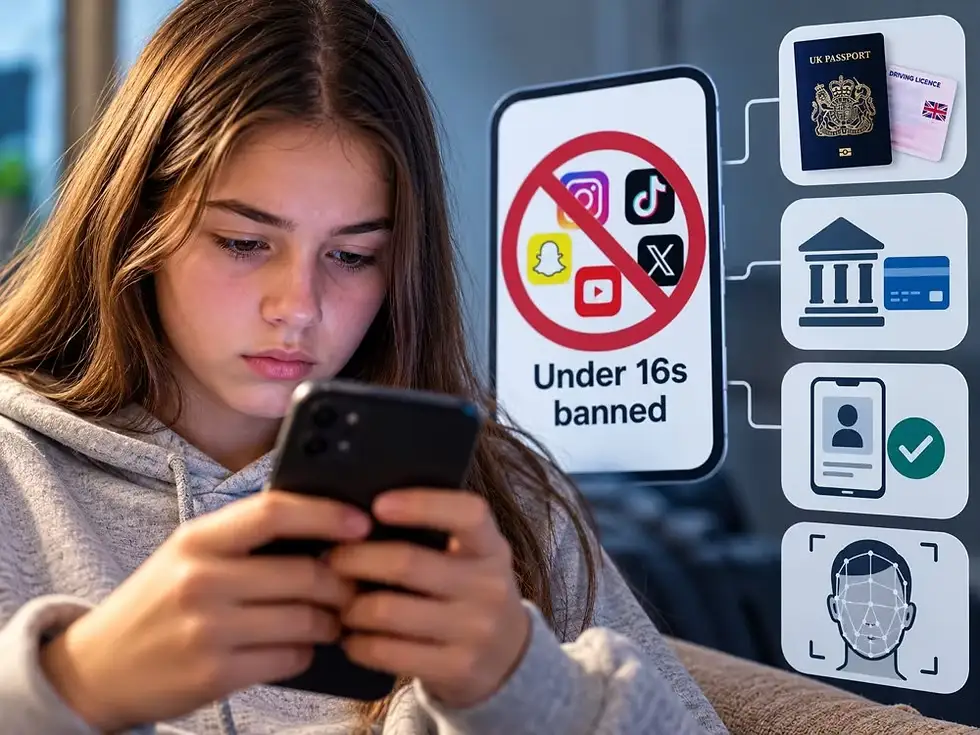
Communications regulator Ofcom has outlined four methods that could be used to verify the age of social media users in Northern Ireland and across the UK, as the Government prepares to ban under-16s from platforms.
The proposed ban, announced in June, is expected to come into force in 2027. Ofcom has identified photo ID matching, banking-based checks, digital ID services and facial age estimation as capable of providing highly effective age checks.
Under the photo ID method, users would provide a passport, driving licence or other accepted photo identification, which would be checked against a live image of their face. Banking-based checks would allow platforms to access age information held by a bank or financial institution with the user's consent.
Digital ID services would enable users to verify their identity through a digital service, potentially allowing repeated confirmation without presenting identification each time. Facial age estimation would use technology to analyse facial features and estimate a person's age.
Ofcom says facial age estimation can be inaccurate by several years around the age of 16, so it recommends a system similar to the Challenge 25 approach used by retailers selling alcohol. Platforms would set a higher age threshold for facial estimation and require further verification where a user appears close to the minimum age.
The regulator notes that some 16- and 17-year-olds may not hold the identification needed to prove they are old enough to access restricted services. Estimates suggest around 150,000 teenagers aged 16 and 17 in the UK have neither a passport nor a driving licence.
About 90% of UK teenagers in that age group are estimated to have a bank account, potentially providing another route to age verification. Young people may need to obtain identification such as a passport, provisional driving licence or a photo identification card certified by the Proof of Age Standards Scheme (PASS).
Although the ban is aimed at children under 16, its introduction could affect adult social media users. Ofcom says platforms may not need to carry out fresh checks where they already hold accurate information establishing that an existing account holder is above the required age, but many adults are still likely to be asked to verify their age.
Ofcom Chief Executive Dame Melanie Dawes said the ban will shape the future of children's lives online. She said it can work if social media firms do highly effective age checks properly, and that Ofcom will be ready to take swift and firm action against any company that fails to comply when it comes into force next year.
Dawes added that motivated children will seek to bypass the restrictions, just like alcohol laws cannot completely eradicate underage drinking, but there will be ways for platforms to mitigate this risk. She said this will be a huge cultural shift for society and will take time to adjust.
The regulator also raised concerns about how app stores establish children's ages. It found that three-quarters of children who use the internet reported that apps downloaded from an app store were their primary means of going online, but all app stores examined currently rely on children declaring their own age.
Ofcom believes app stores could contribute to stronger online protections by introducing more reliable age checks, alongside better information about the risks individual apps pose to children. App stores are not currently regulated under the Online Safety Act.
The Government intends to publish the first regulations before the end of this year, after which Ofcom will consult on detailed guidance for social media companies. The regulator says it will be ready to take enforcement action against companies that fail to comply when the restrictions take effect in 2027.