Retired Pastor Convicted Under Northern Ireland's Safe Access Zone Law After Hospital Protest
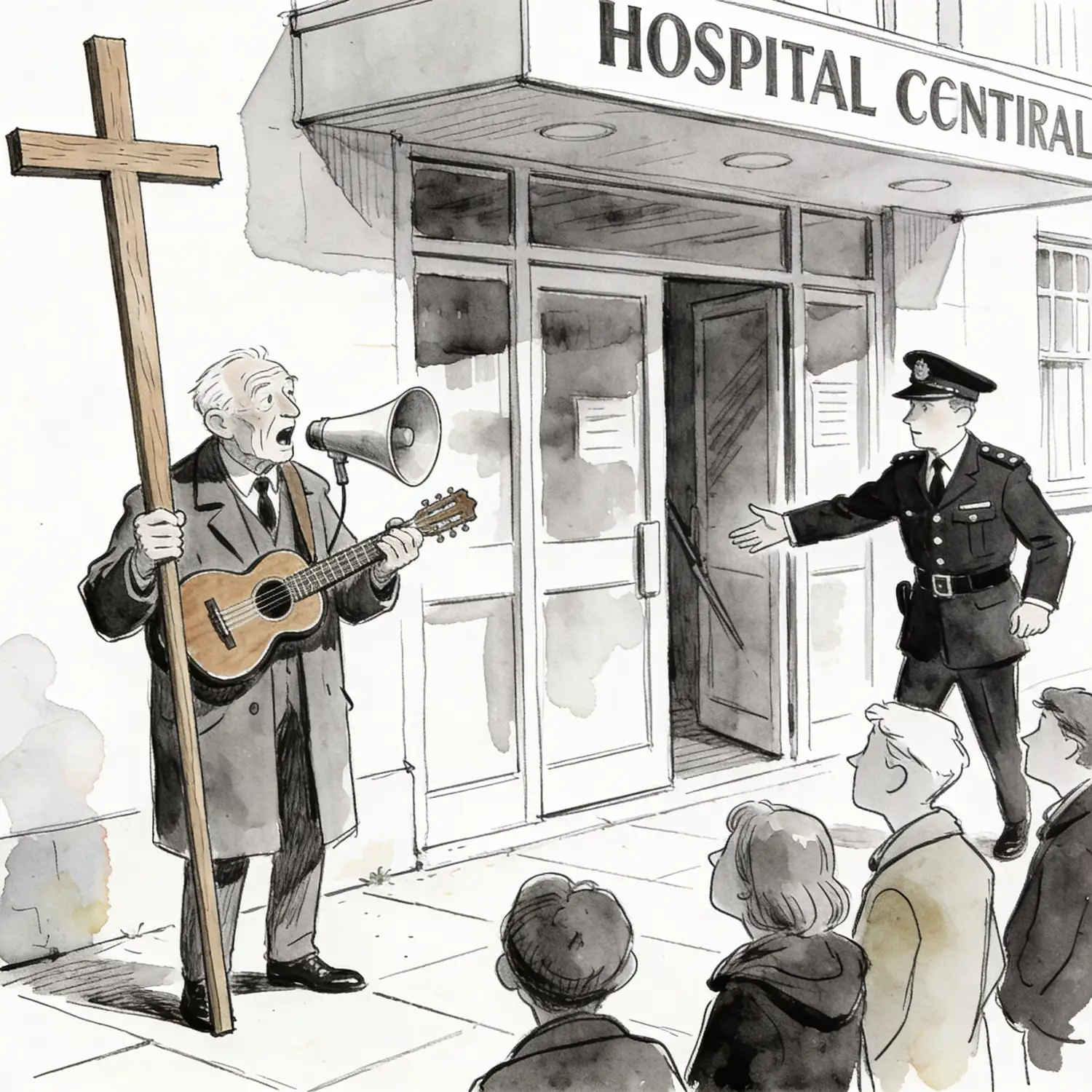
A retired Baptist pastor has been convicted of two offences under Northern Ireland's abortion safe access zone legislation following a religious gathering he organised outside Causeway Hospital in Coleraine in July 2024. District Judge MC King, sitting in the Magistrates' Court in Northern Ireland, delivered the verdict on 7 May 2026, finding Clive Johnston guilty of conducting a protest within a safe access zone and failing to comply with a police direction to leave.
Johnston, who described himself in evidence as a Bible-believing Christian and self-identified pro-life advocate, organised an event called "Return to the Cross" near the hospital on 7 July 2024 - a Sunday. He confirmed in court that he chose a Sunday partly because he believed no abortions would take place that day, and partly because it is the Christian day of worship. He was wrong in his assumption: evidence from Jeremy Foster, then Assistant Director of Corporate Support Services for the Northern Health and Social Care Trust, confirmed that the Trust operates a seven-day abortion service and that on that specific Sunday a clinical lead was delivering therapeutic aftercare as part of that service.
Police were aware of the planned event in advance. Inspector O'Brien made contact with Johnston from 3 July 2024, providing links to the relevant legislation and warning him in writing on 5 July that his intended actions would give rise to a reasonable suspicion of an offence. Johnston replied to that correspondence expressing hope the event would proceed graciously and peacefully. He did not alter his plans.
At the event, Johnston preached through a PA system, played a ukulele, and carried a large wooden cross. There were no placards, banners, or leaflets. Johnston had given prior undertakings to police not to mention abortion or distribute leaflets, and those undertakings were honoured. The word "abortion" was not used. About nine people attended. Body-worn camera footage captured by Inspector O'Brien from 15:04 hrs was viewed by the court and ran until 15:41 hrs.
When police directed the group to leave the safe access zone, most complied. Johnston refused, stating "I am not moving." He was formally cautioned under the Criminal Evidence (Northern Ireland) Order 1988 and left the zone within ten minutes - but the judge found he did so at a time of his own choosing rather than in compliance with the direction. Johnston confirmed in cross-examination that his decision not to leave immediately was deliberate, and that he had been within the safe access zone partly to test the legislation. He also agreed that every time he preached he hoped someone would respond, and that his preaching was designed to influence people towards the Bible.
The judge rejected a defence argument that the prosecution was required to prove the actual presence of an identifiable protected person at the time of the alleged offence. Drawing on the language of the Abortion Services (Safe Access Zones) Act (Northern Ireland) 2023 and the earlier UK Supreme Court ruling in the Attorney General's reference concerning the Bill - [2022] UKSC 32 - the court concluded that section 5(2) prohibits categories of behaviour within a safe access zone and that the offence refers to a notional protected person rather than requiring a named complainant. The judge noted that the Supreme Court had already determined that a conviction under section 5 does not constitute a disproportionate interference with Convention rights under Articles 9, 10 and 11 of the European Convention on Human Rights, and that no further proportionality assessment was required.
The defence also asked the court to refer a series of devolution issues to the Court of Appeal, including questions about whether the legislation was within the legislative competence of the Northern Ireland Assembly. The judge declined, finding that the original four issues sought to re-litigate matters already settled by the Supreme Court, and that the two additional issues concerned statutory interpretation rather than legislative competence. The court found none of the proposed referrals had a reasonable prospect of success.
Johnston was found guilty of both complaints. The section 5 offence carries a maximum fine of £500, and the section 6 offence a maximum fine of £2,500. The judge noted Johnston is of good character and had engaged with police openly and without subterfuge throughout.