Irish Language Conference Hears Analysis of Parading and Rights at Contested North Belfast Route
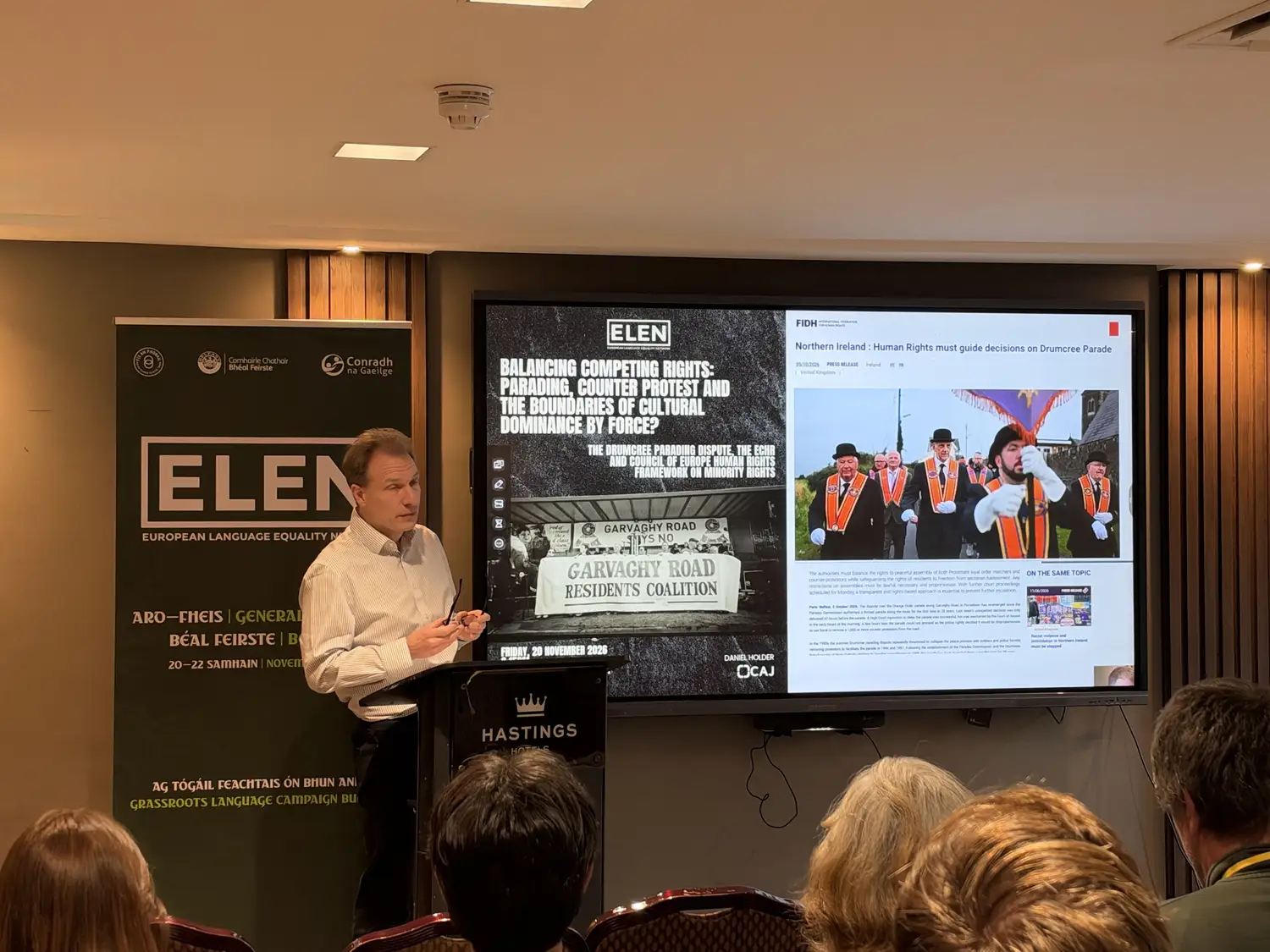
A conference on Irish language planning has heard a detailed examination of the legal and historical context surrounding a contested Orange Order parade route in north Belfast.
The ELEN conference, held in Belfast for the first time, was organised by Conradh na Gaeilge in cooperation with Fís an Phobail, the Irish language planning network for west Belfast.
Daniel Holder, director of the Committee on the Administration of Justice, delivered a speech titled "Balancing Competing Rights: Parading, Counter Protest and the Boundaries of Cultural Dominance by Force?"
He outlined the political background and history of the Orange Order's desire to march on the Crumlin Road and the reasons residents opposed the parade. He said the Crumlin Road dispute was one of two stories from Northern Ireland that received international news coverage, alongside racial disorder during the summer.
Holder described the Orange Order as the largest of the loyal orders and said it continues to be highly active, with thousands of marchers each year. He said the organisation played a central role in the Northern Ireland state between 1921 and 1972, and that the old state operated in a single-identity and single-culture manner until the Good Friday Agreement in 1998.
He said the decline of the Irish language formed part of a colonial project prior to the foundation of the northern state as a mono-cultural entity, but that the question was mixed. He noted that Orange Order members had promoted the Irish language in the late nineteenth and early twentieth centuries, and that this ended with the establishment of the northern state as single-language and single-culture.
Holder explained the CAJ's submission to the International Federation for Human Rights regarding the Crumlin Road. The first part of that statement said authorities have a duty to manage the rights of peaceful assembly for Protestant Orange Order marchers and counter-protesters, and the rights of residents to live free from sectarian harassment.
He outlined the history of parading in the 1990s, referring to the deaths of Rosemary Nelson, Michael McGoldrick, Robert Hamill and Dermot McShane. He explained the establishment of the Parades Commission and said every application for the Crumlin Road parade had been refused since 1998 until this year's application. He described the events of this year, from the commission's initial decision in the summer to the decision by Secretary of State Chris Bryant to block the parade.
He referred to Article 11 of the European Convention on Human Rights, the right to freedom of assembly, and its relevance to the counter-protest on the Crumlin Road. He said the Council of Europe and the United Nations describe sectarianism in Northern Ireland as a form of racism.
Holder drew connections between the Crumlin Road case and other parading disputes internationally, including Skokie in the United States in 1977 and the Magyar Gárda in Hungary. He said the Orange Order played a central role in the state when it was single-culture and explained the order's constitution today. He raised questions about the order's desire to walk the road and concluded with questions for the audience about the impact of these events on communities.
Asked about the Orange Order's position on bilingual signs in Portadown, he said the argument that Irish and Irish signs would damage community relations was a pretext.