Court of Appeal upholds four-year sentences for brothers who helped murderer escape justice after Ballymoney killing
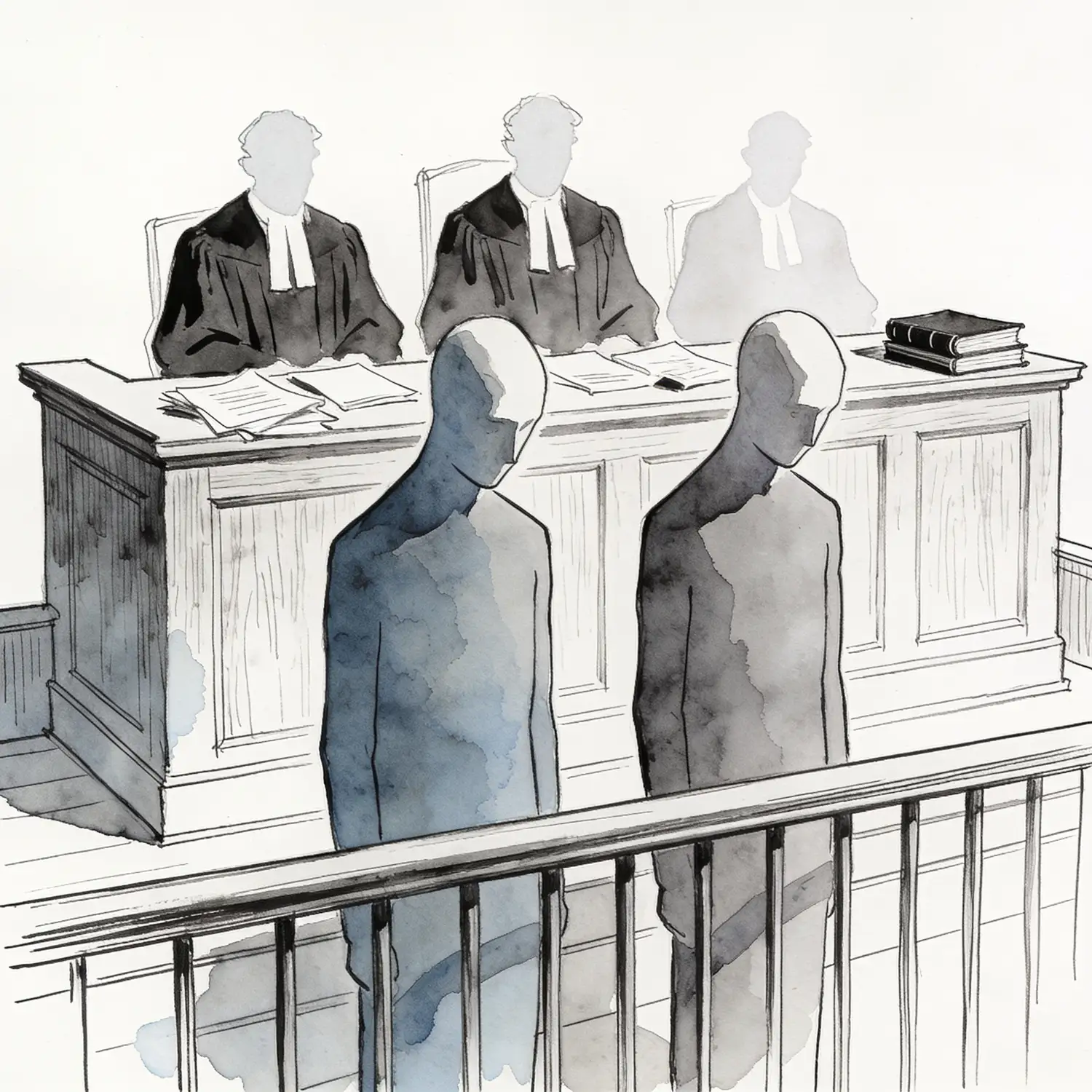
The Court of Appeal in Northern Ireland has dismissed sentence appeals brought by two brothers convicted of helping a murderer evade justice following the killing of Steven Peck in Ballymoney. Stephen McCook and Brian McCook each received a four-year sentence, split equally between custody and licence, after pleading guilty to assisting an offender contrary to section 4(1) of the Criminal Law Act (Northern Ireland) 1967. The appeals were heard by Keegan LCJ, Colton LJ and McAlinden J, with judgment delivered on 4 August 2026.
The brothers had originally been charged with murder alongside David Austin, who pleaded guilty to killing Steven Peck on 3 January 2021 in playing fields behind the Joey Dunlop Centre in Ballymoney. The trial judge directed the jury to acquit the McCooks of murder midway through proceedings, after which both entered guilty pleas to the assisting offender charge.
Under the agreed basis of plea, both brothers admitted being present at Austin's home at 16 Cherry Gardens, Ballymoney, before and during his departure to ambush Peck. They accepted they provided Austin with a safe haven while aware that police were conducting house-to-house enquiries nearby, helped dispose of incriminating evidence, failed to alert emergency services to assist Peck, lied to police throughout the investigation, and obstructed the police inquiry through those lies and their involvement in destroying evidence.
Both appellants argued the sentencing remarks lacked transparency about how the judge reached his conclusions. The prosecution conceded that point. However, the court held that a lack of transparency in the original sentencing exercise did not automatically lead to a reduction. The court conducted its own analysis and found a starting point in the range of four to five years, with a 20% reduction for guilty pleas, justified a final sentence of four years. The maximum penalty for assisting an offender in a murder case is ten years.
The court applied a three-part framework drawn from the England and Wales case Attorney General's Reference (No.16 of 2009), considering the nature of the underlying crime, the extent of the assistance provided, and the degree to which that assistance damaged the interests of justice. On all three measures, the court found the offending was at a high level. The court also rejected a narrow interpretation of the interests of justice test, stating it extends beyond simply how quickly a principal offender was caught.
Arguments were made on behalf of Stephen McCook, relying on a report from educational psychologist Mr Dwyer, that low IQ and personal vulnerability should distinguish his position from that of his brother. The court considered those submissions but declined to draw a distinction between the two appellants, concluding the joint basis of plea and overall circumstances of the case made any such separation inappropriate.
A separate argument that Stephen McCook's sentence should have been suspended was also rejected. The court noted that suspension requires exceptional circumstances under Northern Ireland law, referencing the cases of R v Devlin [2023] NICA 71 and R v Ruddy [2025] NICA 13. While acknowledging the personal circumstances and vulnerabilities raised on Stephen McCook's behalf, the court found that the seriousness of the offending outweighed those factors. Both appeals were dismissed.